Business Exit Readiness Checklist: 12 Essential Items
16 February 2026
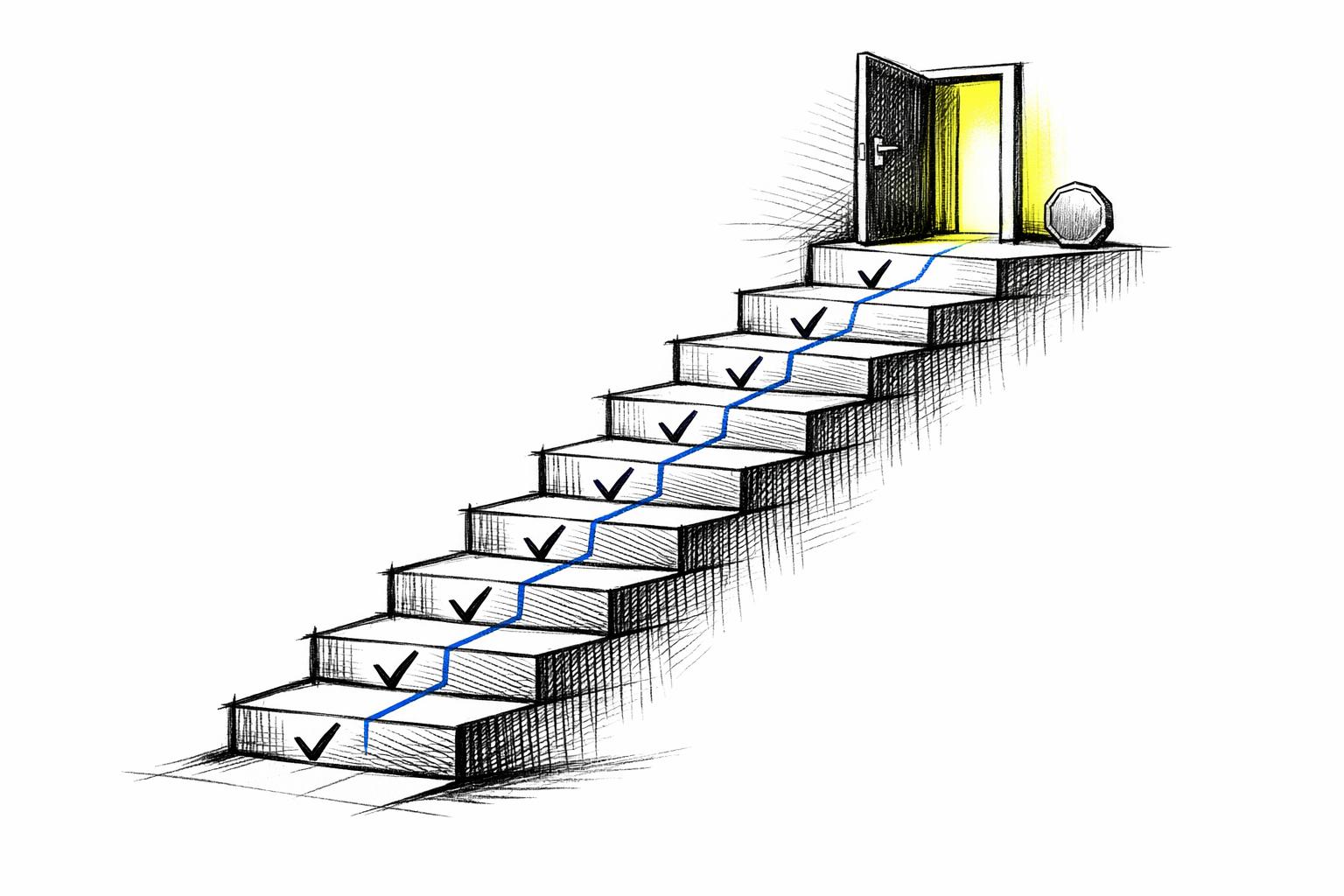
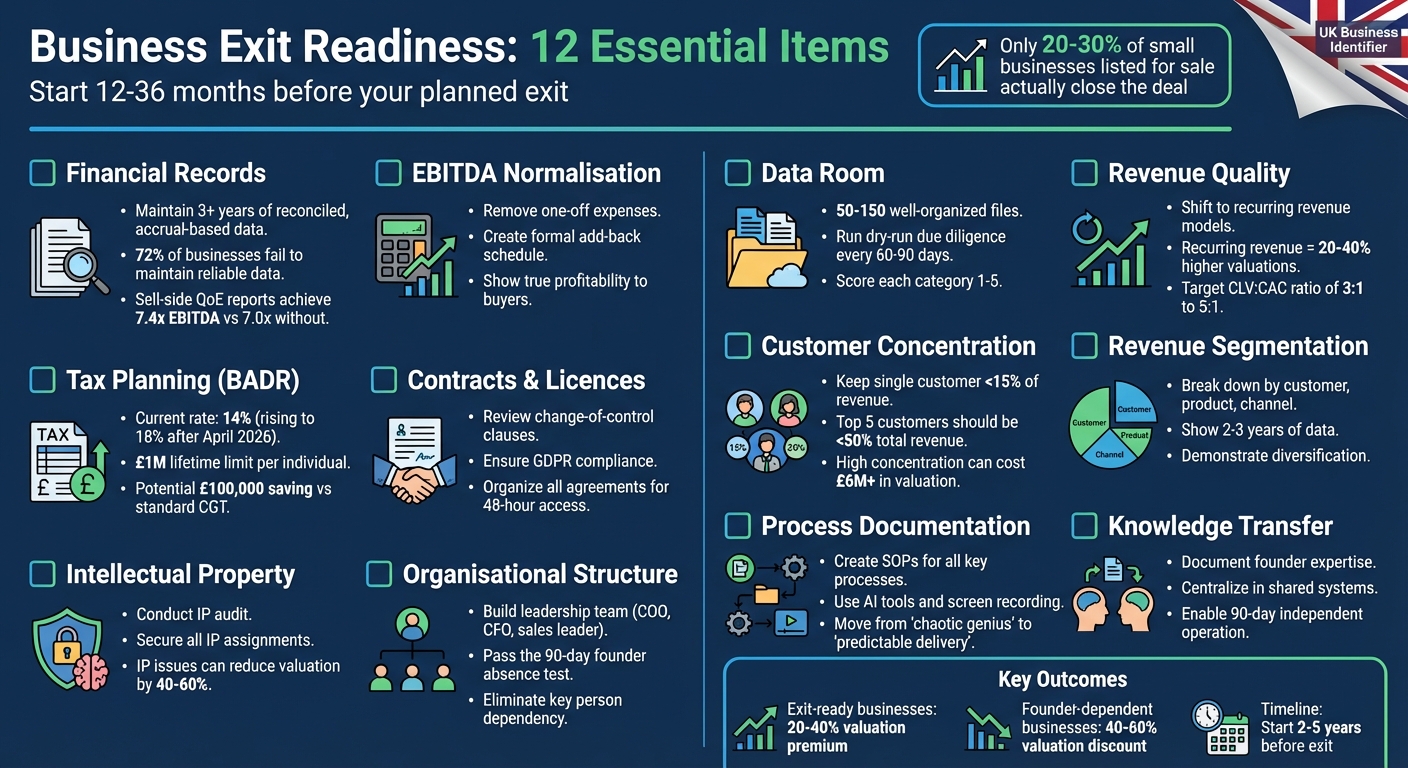
Preparing your business for a sale is not just about finding a buyer; it’s about ensuring your company is structured, independent, and attractive to potential buyers. Most small businesses fail to sell due to founder dependency or poor preparation. This checklist breaks down 12 actionable steps to help UK business owners maximise valuation and streamline the exit process. Key areas include:
- Financial Records: Maintain at least three years of reconciled, accrual-based financial data. Normalise EBITDA by removing non-recurring expenses to reflect true profitability.
- Tax Planning: Understand Business Asset Disposal Relief (BADR) rules to reduce Capital Gains Tax. Plan sales before April 2026 to avoid higher tax rates.
- Contracts and Licences: Review and organise all contracts, ensuring no change-of-control clauses jeopardise the sale. Confirm GDPR compliance for data protection.
- Intellectual Property (IP): Ensure all IP is owned by the business through proper assignments. Conduct an IP audit to verify registrations and ownership.
- Organisational Structure: Eliminate founder dependency by documenting processes, delegating responsibilities, and building a leadership team.
- Data Room: Create a well-organised data room with key documents ready for due diligence. Simulate buyer requests to identify gaps.
- Revenue Quality: Shift to recurring revenue models and minimise customer concentration to reduce risk and boost valuation.
- Founder Knowledge Transfer: Document expertise and implement systems to ensure the business can operate without the founder.
Starting 12–36 months before a planned exit allows time to address issues that could lower valuation or scare off buyers. A well-prepared business not only attracts buyers but also commands higher offers, ensuring a smoother and more profitable exit.
Business Exit Readiness: 12 Essential Preparation Steps for UK Business Owners
How to Prepare Your Company for a Successful Exit
sbb-itb-9e8c2f9
Financial Records & Management Accounts
When preparing for a sale, buyers usually expect at least three years of reconciled financial records. This includes profit and loss statements, balance sheets, and cash flow statements, along with a year-to-date financial summary. Maintaining clean, accrual-based accounts is essential – it allows for straightforward comparisons and shows that the business is managed with precision rather than guesswork. Without this clarity, buyers may question the accuracy of the figures or suspect the owner lacks a firm understanding of the business’s actual performance. Transparency in financial records is key to building trust and demonstrating strong financial controls.
"Buyers pay for certainty – reduce surprises and you increase the value of your company; increase ambiguity and buyers discount value or walk away." – Ascent CFO
Interestingly, 72% of businesses fail to maintain reliable and consistent data for exit preparation. However, those that complete a sell-side Quality of Earnings (QoE) report before entering the market achieve higher valuations – 7.4x EBITDA, compared to 7.0x for those that don’t. Verified and reconciled financials eliminate doubt, reinforcing buyer confidence.
Reconciled Financial Data
To ensure your financials are ready for scrutiny, reconcile all bank accounts, receivables, payables, inventory, and accrued expenses with supporting documentation. Implement a monthly close process that wraps up within five business days, and lock prior periods to maintain a 12–18-month digital audit trail. Any discrepancies between management accounts, tax filings, and the general ledger can signal weak financial controls, which increases perceived risk.
Additionally, remove personal or lifestyle expenses from business accounts as soon as possible. Buyers won’t pay for non-business-related costs like gym memberships or family holidays. By separating these expenses, you ensure that historical EBITDA accurately reflects the company’s operational performance. Once the financial data is verified, adjusting EBITDA for non-recurring items further highlights the business’s true profitability.
EBITDA Normalisation
Normalising EBITDA is a critical step in preparing for an exit. It involves removing one-off or irregular items that might distort the business’s sustainable profitability. Create a formal "add-back schedule" that clearly documents each adjustment – such as legal fees, redundancy costs, or temporary contractor expenses – with proper supporting evidence. This process provides buyers with a realistic view of the earnings they can expect going forward.
"The earnings are based on the historical and projected performance of your business, adjusted for any one-off or non-underlying items that may distort the true picture of your profitability." – KPMG
A well-documented normalised EBITDA not only strengthens your valuation during due diligence but also helps prevent last-minute price reductions. Use visual aids to clearly link changes in margins or revenue to specific factors, such as pricing updates or shifts in sales volume.
Revenue Segmentation
Breaking down revenue by customer, product, and channel for the past two to three years can further boost buyer confidence. This segmentation highlights diversification and stability – key factors that buyers look for. For instance, if one client contributes more than 15% of your total revenue, this concentration risk could result in valuation discounts.
A case from 2024 illustrates the importance of reliable data. A portfolio company spent six weeks compiling monthly revenue data by customer segment because the information was scattered across Salesforce, QuickBooks, and Excel. The inconsistencies led to mistrust, and the buyer reduced their offer by £6.4 million, equivalent to one full EBITDA multiple. Unreliable data doesn’t just slow down deals – it can jeopardise them entirely.
"Unreliable and inconsistent data can result in a much lower purchase multiple. It creates mistrust and gives buyers a reason to decrease their offer." – Entrepreneur
To avoid such pitfalls, monitor your top 10 and top 20 customers not just by revenue but also by factors like tenure and renewal terms, which demonstrate customer loyalty. Ensure consistent definitions for recurring revenue and customer segments over the three-year period. Test your finance team’s ability to produce reconciled revenue reports by product line or customer segment within 48 hours every 60–90 days. If they can’t, address the gaps immediately.
Tax Planning & Business Asset Disposal Relief (BADR)
Tax planning plays a crucial role in ensuring a successful business exit. In the UK, Business Asset Disposal Relief (BADR) – previously known as Entrepreneurs’ Relief – offers a reduced Capital Gains Tax (CGT) rate on qualifying business sales. However, this relief comes with strict eligibility criteria and requires careful timing. With the BADR rate set to rise from 14% to 18% on 6 April 2026, understanding its intricacies has never been more important.
BADR allows qualifying gains to be taxed at a lower rate, capped at a £1 million lifetime limit per individual. For example, a £1 million gain currently incurs £140,000 in tax at the 14% rate, compared to £240,000 under the standard 24% CGT rate. This represents a potential £100,000 saving when planned correctly.
"From 6 April 2026, the rate will rise further to 18%… This makes careful planning around disposals more important than ever." – Richard Major, Partner, Azets
However, this relief isn’t automatic. You must meet specific criteria: holding at least 5% of the company’s ordinary share capital and voting rights, and being an employee or officer of the company for a full two-year qualifying period. If the company ceases trading, you still have a three-year window to dispose of your shares and qualify. Claims must be submitted by the first anniversary of 31 January following the tax year of disposal. For instance, a sale occurring in the 2025/26 tax year must be claimed by 31 January 2028. Meeting these requirements is essential to securing the relief.
BADR Eligibility
To confirm eligibility, thorough documentation is key. Your shareholding must meet the 5% threshold for ordinary share capital, voting rights, and either profits available for distribution or disposal proceeds. Employment records – such as contracts, P60s, or payroll documents – must verify your role as an officer or employee during the full two-year period. Additionally, financial statements should confirm that the business is actively trading rather than investment-focused. These records not only ensure eligibility but also enhance your overall readiness for an exit.
If you’re considering transferring shares to a spouse or civil partner to use two separate £1 million lifetime limits, they too must meet the two-year employment and 5% ownership requirements. This can effectively double the relief to £2 million. However, such transfers should be completed well in advance, as HMRC closely examines last-minute arrangements. If a new share issue dilutes your ownership below 5%, you can make an election to be treated as if you sold and repurchased your shares immediately before the dilution, preserving your eligibility.
Modelling Tax Scenarios
With the upcoming BADR rate increase, acting promptly is essential. A £1 million qualifying gain taxed at the current 14% rate results in £140,000 in tax, but after April 2026, this rises to £180,000 at the 18% rate – a £40,000 difference [22,23]. For larger exits, the financial impact can grow significantly.
| Period of Disposal | BADR Tax Rate |
|---|---|
| On or before 5 April 2025 | 10% |
| 6 April 2025 to 5 April 2026 | 14% |
| On or after 6 April 2026 | 18% |
"Timing your exit before April 2026 can save thousands, especially with the BADR rate hike looming." – Pro Tax Accountant
Timing isn’t the only factor to consider. Other strategies can help reduce your taxable gain. For instance, you can offset unused capital losses from previous years against your gains to lower your CGT bill. Extracting surplus cash via dividends (using the £500 dividend allowance) or making pension contributions (up to the £60,000 annual allowance, plus any carry-forward) before the sale can also reduce the value of your shares. If you’re closing the business entirely, a Members’ Voluntary Liquidation (MVL) allows distributions to be treated as capital rather than income, potentially qualifying them for BADR instead of higher income tax rates.
It’s important to note HMRC’s anti-forestalling measures, which are designed to prevent artificially locking in lower tax rates through unconditional contracts that complete after rate changes [24,25]. To navigate these complexities, consulting a qualified tax adviser is highly recommended. They can model scenarios tailored to your situation, ensuring compliance and helping you maximise the relief available. Integrating these tax strategies into your broader exit plan will help you make the most of your business sale.
Contracts, Licences & Change-of-Control Clauses
Carefully examining contracts, licences, and change-of-control clauses is a crucial step in safeguarding your business’s independence and long-term appeal to buyers.
Contracts can significantly impact a sale. Buyers will pore over every agreement during due diligence, and change-of-control clauses can be a particular sticking point. These clauses often require third-party consent when ownership changes hands. If a key supplier or customer has the right to terminate their contract due to the sale, it could jeopardise the deal or reduce your business valuation.
Software licensing agreements also demand attention. Developer or reseller contracts frequently include restrictions requiring the original developer’s approval before transferring ownership. If the developer disapproves of the buyer, they could refuse consent, leaving you with a non-transferable agreement. Beyond these clauses, it’s important to review termination and renewal terms. Contracts nearing expiration should be renewed proactively – ideally by adding services or support rather than cutting prices – to offer buyers a reliable revenue stream. This principle of clarity applies to all significant agreements.
"If you can’t show potential acquirers up to date contracts – especially in areas upon which your business is heavily reliant – it could sound a warning bell for them that buying your company is a risky endeavour." – Entrepreneurs Hub
Customer and Supplier Contracts
Looking more closely at customer and supplier agreements, ensuring continuity after the sale is critical.
All essential contracts – whether related to customers, suppliers, loans, or leases – should be well-organised and accessible within 48 hours for due diligence. Each agreement needs to be reviewed to confirm whether it can be assigned to a new owner or if third-party consent is required. For contracts needing consent, establish a consent plan that outlines how and when to approach third parties without risking the relationship.
It’s also important to identify dependencies beyond primary contracts. For example, map the locations of key suppliers and their sub-suppliers to detect potential vulnerabilities or single-source dependencies. Reconcile contract terms – such as pricing, discounts, and service levels – against actual invoices and management reports to avoid discrepancies that could raise concerns during financial due diligence. If any clients have been granted special terms, aim to standardise these wherever possible to simplify the sale process.
GDPR Compliance
In addition to reviewing contracts, ensuring compliance with data protection regulations is essential for a smooth transition.
Data processing agreements must align with Article 28 of the UK GDPR. These agreements should include key elements such as documented instructions, confidentiality obligations, robust security measures, sub-processor rules, audit rights, and clear end-of-contract procedures.
Before sharing data with potential buyers, confirm the original purpose of the data and the lawful basis for sharing it, while adhering to data protection principles like lawfulness, fairness, and transparency. Inform data subjects about any changes to how their information will be used, as they may have the right to object to its transfer during the acquisition process.
| Mandatory Contract Element | Description |
|---|---|
| Documented Instructions | The processor must act only on the controller’s written instructions. |
| Duty of Confidence | Personnel handling the data must commit to confidentiality. |
| Security Measures | Appropriate technical and organisational security measures must be in place. |
| Sub-processor Rules | Prior written consent is required for engaging third-party processors. |
| Audit Rights | The processor must allow and contribute to audits and inspections. |
| End-of-Contract | Clear terms for returning or deleting data when the contract ends. |
To stay prepared, simulate due diligence requests every 60–90 days. Test your ability to produce your top 25 most critical contracts and metrics within 48 hours. This exercise can reveal where knowledge is overly reliant on specific individuals or where documentation is lacking. Transparency is key: buyers are more forgiving of honest disclosures than unexpected surprises.
Intellectual Property Ownership & Protection
After completing contract due diligence, clarifying intellectual property (IP) ownership is critical for maintaining your business’s value. IP often accounts for a large portion of a company’s worth, but unresolved ownership issues can lead to valuation cuts of 40% to 60% or even jeopardise deals entirely. Buyers need certainty: does the business own the trademarks, patents, software, and trade secrets that drive its revenue? If the answer isn’t clear or requires lengthy investigation, expect tougher terms like significant escrows or earnouts.
A common misconception is, "I paid for it, so I own it." In reality, IP ownership hinges on explicit contractual agreements. This becomes especially problematic when key IP is developed without signed assignments.
"IP ownership issues are a common problem that is uncovered during a due diligence process. Whilst these issues can often (but not always) be sorted, if they are only discovered during negotiations they can delay proceedings and may scare some prospective acquirers away." – Stephen Carter, Founder, The Intellectual Property Works
Resolving these gaps early reassures buyers. Missing documents signal a lack of control, and any uncertainty can lead to harsher terms. If core IP was created by third parties without proper agreements, it’s essential to finalise these assignments immediately.
IP Audit
Start by cataloguing all significant IP assets, both registered (patents, trademarks, design rights) and unregistered (copyrights, software code, database rights, trade secrets, domain names). Ensure all registrations are up to date and under the company’s name – not a founder’s personal name or an outdated entity.
Next, verify the chain of ownership for each asset. Any IP created by founders, employees, or contractors must have been legally assigned to the business through written agreements. This is especially important for work done before the company was formally incorporated or by contractors without assignment clauses. If open-source software (OSS) is used in your products, maintain a detailed log of all OSS components, their licences, and compliance status – poor OSS management is a major red flag during due diligence.
A thorough IP audit demonstrates operational independence, which is critical for a smooth exit process. Review all third-party licences to confirm the company has the rights to use IP it doesn’t own and that these licences won’t be revoked during a change of control. Similarly, examine any licences granted to third parties to ensure safeguards against misuse are in place. Lastly, verify that creators have waived their moral rights (the right to be identified as an author), as these rights cannot be transferred like other IP rights.
IP Assignment Clauses
Every employment and contractor agreement should include Proprietary Information and Inventions Assignment (PIIA) clauses, which ensure all IP created during the engagement automatically belongs to the company. While IP created by employees during their work generally belongs to the employer, buyers often insist on explicit assignment clauses in contracts. For contractors and freelancers, IP ownership isn’t automatic – without a signed agreement, they retain the rights.
If gaps are identified, such as a contractor developing core functionality without an assignment, address these immediately by executing standalone assignment agreements. For departing employees, secure a "reaffirmation" of the PIIA that specifically addresses their contributions. Taking these steps builds buyer confidence and shows that the business operates systematically rather than relying solely on its founders.
| IP Type | Protection Method | Ownership Rule (Default) |
|---|---|---|
| Trademarks | Registration (UKIPO) | Owned by the registering entity. |
| Copyright | Automatic upon creation | Employer (if by employee); Creator (if contractor). |
| Patents | Grant by Patent Office | Inventor (requires formal assignment to the company). |
| Trade Secrets | Reasonable steps to protect | Owned by the business if controlled and kept secret. |
| Design Rights | Automatic or Registered | Employer (if by employee); Creator (if contractor). |
Centralise all IP-related documents, including assignment agreements and licences, in your data room. Conduct a "dry-run" audit 6 to 24 months before an exit to identify and resolve ownership gaps before potential buyers uncover them. Establishing solid IP ownership is a key part of preparing for a successful exit, complementing the broader financial and operational readiness discussed earlier.
Organisational Structure & Succession Planning
Once intellectual property is secured and contracts are streamlined, the next step is ensuring your business can function smoothly without relying heavily on its founder. Buyers are willing to pay more for businesses that operate on predictable systems rather than those that depend on the extraordinary efforts of an individual.
"Systems-dependent beats owner-dependent every time." – Stefania Arca, Founder, International Exit Strategy
Take the example of a London-based creative agency that generated £8 million in revenue. In 2025, it underwent a 12-month transformation led by Stefania Arca. At the start, 85% of client relationships required the founder’s direct involvement, and no documented processes existed for delivery. After conducting a "Crisis Prevention Audit", which identified 23 operational bottlenecks, the agency transferred client relationships to team leads and implemented standardised processes. By the end of the transformation, the business managed a 30-day founder absence without any disruptions. This operational overhaul enabled the agency to sell to a strategic buyer at a 40% premium over its initial valuation. This case highlights how documenting processes is a crucial step in addressing dependency on key individuals.
Mapping the Organisation
Start by creating an organisational chart that not only lists job titles but also defines decision-making authority and identifies successors for essential roles. Structured interviews with department leaders can help uncover where performance outcomes, risks, and reported evidence don’t align. Misalignment in decision-making responsibilities often signals structural weaknesses.
Next, map out the ownership of every step in your delivery process, focusing on areas prone to failure. If success hinges on one person’s exceptional input, it’s a red flag for dependency risk. Perform a key-person scan to identify roles where critical knowledge is concentrated. Then, delegate responsibilities or introduce multi-threading strategies to distribute expertise across the team.
Formalising the management structure is another vital step. Ensure you have clearly defined leadership roles, such as a COO, CFO, and sales leader, who can independently drive growth. Once the organisational structure is clear, you can actively work to reduce key person risk.
Eliminating Key Person Risk
The Two-Week Test is a practical way to assess leadership gaps: if the business struggles during a two-week founder absence, there’s a problem. To be fully prepared for an exit, aim for the business to operate seamlessly for 90 days without any founder involvement.
To achieve this, establish a consistent leadership rhythm. This could include weekly KPI reviews, monthly management meetings, and a rolling 90-day OKR (Objectives and Key Results) cycle to shift the focus from reactive problem-solving to proactive management. Additionally, build redundancy into key customer and supplier relationships by involving multiple team members rather than relying on the founder.
Empower your team by implementing protocols that allow them to make decisions without needing the founder’s approval. Create a centralised digital vault for core enterprise technology to eliminate the founder as a single point of failure. Using a pre-mortem approach can also be insightful – ask leaders, “If the deal fell apart in the last two weeks, what would have caused it?” This often reveals vulnerabilities that a traditional SWOT analysis might miss.
These steps not only reduce reliance on individuals but also strengthen the business’s operational resilience, making it more attractive to potential buyers.
Data Room Architecture & Due Diligence Preparation
Once your business structure is running smoothly, the next step is to create a well-organised data room. This is where potential buyers can verify every claim you make about the business. A properly set-up data room turns due diligence from a stressful scramble into a streamlined process.
"Exit readiness is a buyer-confidence problem, not a housekeeping problem. A buyer does not pay you for effort; they pay you when they understand the business, can verify the numbers, and can own it without surprises." – Umbrex
Missing or incomplete documents can raise red flags for buyers, often signalling weak internal controls. For early-stage transactions, a typical data room might contain 50 to 150 carefully selected files. Ideally, businesses should start preparing for an exit 1–2 years before the intended sale date. This preparation ensures that your operational readiness aligns with the buyer’s need for transparency and accuracy.
Complete Documentation
The data room should have a clear, logical folder structure, making it easy for buyers to navigate. A typical setup might include:
- 0-Overview: A one-pager, KPI dashboard, and cap table snapshot.
- 1-Corporate: Articles of association, board meeting minutes, and shareholder agreements.
- 2-Finance: Profit and loss statements, balance sheets (covering the last 24–36 months), tax filings, and bank reconciliations.
- 3-Commercial: Top 20 customer contracts, revenue breakdowns by product and region, and churn analysis.
- 4-Legal & IP: IP assignment agreements, patent and trademark filings, and litigation records.
- 5-People & HR: Organisational charts, employment agreements, and ESOP plans.
- 6-Security & Compliance: Regulatory licences, data protection impact assessments, and insurance schedules.
Use ISO date formats and semantic file naming (e.g., ‘2026-02-16_Board-Minutes-Q4.pdf’) to keep everything orderly. Each folder should have an introductory document summarising its contents, noting any gaps, and listing relevant contact details. For critical systems like your CRM or HRIS, include guest usernames and passwords in these summaries so buyers can access them directly. To maintain data accuracy, use a document tracker that logs the owner and last update date for each file.
Sensitive information, such as personally identifiable information (PII) or proprietary trade secrets, should be redacted in publicly accessible contracts. However, unredacted versions should be stored in a restricted-access folder for late-stage due diligence. This level of organisation ensures that all exit readiness measures are fully verifiable by potential buyers.
Dry-Run Due Diligence
Once your data room is set up, run a mock due diligence exercise to identify and address any gaps. Every 60–90 days, simulate a buyer’s request by producing 25 key documents within 48 hours. This practice highlights any bottlenecks in your process.
Score each category in your data room on a scale of 1 to 5. Categories scoring 3 or lower should be assigned to a specific owner with a clear deadline for improvement before engaging with buyers. To uncover hidden risks, use a pre-mortem approach by asking, "If the deal fell apart in the final two weeks, what would have caused it?" This can reveal issues that a traditional SWOT analysis might overlook.
Keep a Q&A log during the dry run. This log should record questions, answers, and links to supporting documents, ensuring consistency in future buyer interactions. According to Vista Point Advisors, a well-organised due diligence process should feel confirmatory – by the time you enter exclusivity with a buyer, they should simply be verifying facts rather than uncovering surprises.
It’s crucial not to grant buyers access to the data room until it’s fully populated. Treat the data room as a living, up-to-date record of your business, rather than something hastily assembled for a deal. This approach transforms due diligence from a high-pressure event into a routine checkpoint.
Revenue Quality & Recurring Income
Having your systems and records in order is crucial, but a predictable revenue stream is what truly makes your business attractive to potential buyers. Once your financial and legal groundwork is solid, the next step is to focus on the quality of your revenue, as this has a direct impact on valuations.
Buyers are willing to pay more for businesses with predictable income. For example, consulting firms with retainer agreements or multi-year contracts can achieve 20–40% higher valuations compared to those relying on project-based work. The reason? Recurring revenue reduces risk. When income flows consistently through subscriptions, contracts, or memberships, buyers feel more confident about future earnings and are more willing to invest in growth or take on debt.
"Recurring revenue is your business’s dependable paycheck. Unlike one-time purchases, it arrives regularly via subscriptions, contracts, or memberships." – Aaron Bennett
Predictability in revenue also translates into higher valuation multiples. For instance, consulting firms without retainers often sell at 0.5–4× annual revenue, while concierge medicine practices with steady membership fees can command 6–10× EBITDA. In contrast, project-based businesses face the challenge of starting each period from scratch, constantly needing to replace lost customers. This uncertainty increases perceived risk and lowers valuation.
Beyond valuations, recurring revenue also strengthens cash flow. Retaining existing customers is much more cost-effective than acquiring new ones – repeat customers cost 5 to 7 times less to reacquire and generally spend more per transaction. A healthy business typically aims for a Customer Lifetime Value (CLV) to Customer Acquisition Cost (CAC) ratio of 3:1 to 5:1. Improving these metrics before selling your business signals to buyers that growth can be achieved without significant spending on new customer acquisition.
Recurring vs. Project-Based Revenue
Start by auditing your revenue streams. Classify all income into three categories: recurring (e.g., subscriptions or retainers), recurring-adjacent (e.g., repeat purchases without formal agreements), and non-recurring (e.g., one-off projects or sales). This exercise will highlight areas where you can shift towards a recurring revenue model.
Transforming one-off sales into recurring income is a powerful strategy. For example:
- Marketing agencies could move from ad-hoc campaigns to ongoing content management retainers.
- Equipment suppliers might bundle upfront sales with maintenance contracts or consumable replenishment programmes (think of the "Gillette" model).
- Professional services firms could package their expertise into standardised monthly or annual offerings.
Additionally, adopting multi-year agreements with auto-renewals and incentives for upfront payments can improve both cash flow and customer retention. Aiming for a Net Revenue Retention (NRR) above 100% demonstrates that your business grows through existing customers. Buyers often use the "Rule of 40" (Growth Rate + Profit Margin > 40%) to assess the health of recurring revenue businesses during exit planning.
Once your revenue model is optimised, the next step is addressing customer concentration.
Customer Concentration Analysis
After refining your revenue streams, ensure your customer base is well-diversified. High customer concentration is a common deal-breaker for buyers. Typically, alarm bells ring when a single customer accounts for more than 10% of annual revenue. If one client contributes over 20%, or if your top five customers collectively account for more than 50%, buyers may significantly reduce their valuation offers.
"Customer concentration – when a significant portion of revenue comes from a small number of customers – is one of the most common issues that reduces valuations or kills deals entirely." – Eagle Rock CFO
The financial impact can be severe. For instance, a company with £3 million EBITDA and 35% customer concentration might be valued at £15 million (5× multiple) instead of £21 million (7× multiple), resulting in a £6 million loss in value. Private Equity firms are especially cautious, often requiring concentration to stay below 20%. However, strategic acquirers may tolerate higher levels (25–30%) if they already serve that customer or see opportunities to cross-sell.
To avoid valuation penalties, aim to reduce any single client’s share of revenue to below 15–20%. You can calculate this exposure using the formula:
(Customer Annual Revenue / Total Annual Revenue) × 100.
The most effective way to tackle concentration is through "dilution by growth" – growing revenue from smaller accounts faster than your largest client’s revenue. Strategies include:
- Increasing the Average Contract Value (ACV) of smaller accounts through upselling or cross-selling.
- Creating an Ideal Customer Profile (ICP) based on your top customer’s traits (e.g., industry, challenges, buying habits) to attract similar high-value clients.
Within your key accounts, build relationships with multiple stakeholders to ensure that revenue doesn’t depend on a single person. Documenting "switching costs", such as system integrations or long-standing contracts, can also reassure buyers that customers are unlikely to leave post-sale. Keep in mind that reducing concentration effectively can take 2 to 4 years, so it’s best to start early.
Founder Knowledge Transfer & Business Independence
Businesses that rely heavily on their founders face valuation discounts of 40–60%, making it crucial to establish independence. In fact, only 20–30% of small businesses put up for sale actually close the deal, often due to excessive reliance on the owner. This section focuses on transferring founder knowledge into the organisation, ensuring it can run smoothly without constant involvement.
"If the business depends on you, they’re not buying an asset. They’re buying themselves a job with your face on it." – Stefania Arca, Founder, International Exit Strategy
By 2026, buyers are expected to favour businesses with "predictable delivery" over "chaotic genius", seeking operations that can function independently for at least 90 days. Properly documented systems can boost your valuation multiple significantly – for instance, from 4× to 5× EBITDA. While standardised processes lay the groundwork, transferring your expertise is the next crucial step.
Documenting Expertise
Start by capturing your unique problem-solving methods, shortcuts, and negotiation strategies. Self-interviews can help formalise your decision-making processes. Create Standard Operating Procedures (SOPs) for every step of the customer journey, from the first lead to renewal, ensuring seamless hand-offs between departments.
Centralise this knowledge in a shared hub, such as a wiki, project management tool, or cloud-based document system, to store decision frameworks and the "unspoken rules" of your business. Move details like client preferences and relationship histories from your memory to a CRM platform like HubSpot, ensuring that critical information is accessible to your team. Empower your staff with "Empowerment Scripts", which allow them to make decisions and advance projects without waiting for your approval.
Using AI-Powered Tools
Digital tools can make the knowledge transfer process faster and more efficient. Screen-recording software like Loom can capture tasks in real time and convert them into clear, actionable SOPs. AI platforms can automatically document recurring tasks across operations, customer service, and finance, turning them into repeatable procedures.
Advanced AI systems can even replicate expert decision-making frameworks, preserving your insights for future use. Centralised, AI-driven knowledge hubs ensure that critical information remains intact and accessible, even with staff turnover. To test how independent your business truly is, try a "practice holiday" – a two-week break where you completely unplug and let the business operate without you. The goal? Stability or growth in your absence. Finally, make sure all core technology and credentials are centralised and secure, further reducing founder dependency.
Conclusion
Getting your business ready for an exit is a thoughtful process that ideally starts 2–5 years before you plan to sell. The 12-point checklist we’ve covered tackles the key areas that influence whether your business is seen as a transferable asset rather than one tied to you as the owner. From organised financial records and normalised EBITDA to documented standard operating procedures (SOPs) and AI-driven knowledge systems, each piece plays a role in moving your business from being owner-reliant to being systems-driven. This approach ensures that everything – from finances to operational systems and knowledge transfer – is accounted for.
The reality is that only 20–30% of small businesses listed for sale actually find a buyer, often due to heavy founder dependence or the absence of documented processes. On the flip side, businesses that are exit-ready can attract a 20–40% premium in valuation, while those with weak systems risk facing discounts of 40–60%. Starting early reduces the chances of losing value and can even increase your valuation multiple significantly.
As Stefania Arca, Founder of International Exit Strategy, puts it:
"Exit-ready operations aren’t about selling, they’re about building a business that works without you."
By addressing these 12 items, you gain the flexibility to choose between options like a trade sale, private equity investment, or internal succession, instead of being forced into a rushed or reactive exit. More importantly, your business will deliver consistent results and run smoothly, even without you at the helm.
Taking these steps doesn’t just prepare your business for sale – it builds confidence among potential buyers, creates efficient systems for your team, and secures your financial future. Start early, follow the checklist, and set the stage for a successful and rewarding exit.
FAQs
How do I know if my business is too founder-dependent to sell?
A business may be too reliant on its founder if it struggles to function efficiently without your direct input in major decisions, day-to-day operations, or specialised knowledge. This dependency can be a red flag for potential buyers, often reducing the company’s valuation due to the risks it poses. To gauge how prepared your business is, consider whether it could operate independently for three months. Achieving this requires implementing clear processes, delegating responsibilities effectively, and cultivating a leadership team capable of running the business without constant oversight.
What should I include in a buyer-ready data room?
A data room prepared for buyers should house neatly arranged and precise documents to simplify due diligence and instil confidence in potential buyers. Essential materials to include are financial statements, legal and corporate records, customer and supplier agreements, intellectual property documentation, operational manuals, and compliance records. Make sure all files are thorough and logically organised to facilitate an efficient review process.
Which risks reduce my valuation the most before a sale?
When it comes to selling a business, certain risks can significantly lower its valuation. Key issues include finance functions overly reliant on the founder, data that’s unreliable or inconsistent, a heavy reliance on just a few customers, and an absence of documented, scalable processes. These factors raise red flags for potential buyers, making the business seem riskier and potentially less appealing, which can negatively affect the sale price.
Related Blog Posts
Create the Flexibilty You've Always Craved
Reclaim control and build real independence.
We respect your inbox. No spam, just meaningful updates.