Why Your Team Can’t Make Decisions Without You
18 February 2026

You’re the bottleneck. If every decision in your business still needs your approval, you’re slowing things down and limiting growth. Founder dependency – the habit of keeping all decision-making centralised – often develops in the early days of a business but becomes a major problem as your company scales.
Here’s what happens when you don’t let go:
- Delays: Projects stall because your team waits for sign-offs.
- Burnout: You’re working 80-hour weeks with no time for strategy.
- Employee turnover: Talented staff leave when they’re not trusted to act independently.
The solution? Build systems that empower your team to make decisions without you. This involves:
- Documenting your knowledge: Turn your expertise into clear processes and guidelines.
- Introducing decision frameworks: Define who makes which decisions and set approval thresholds.
- Using technology: Tools like AI-powered knowledge hubs and automation can reduce your involvement in routine tasks.
Delegating isn’t about losing control – it’s about creating a business that runs smoothly without you. When you free up your time, you can focus on growth, innovation, and long-term goals.
Master the Art of Delegation: 5 Essential Strategies for Leaders
sbb-itb-9e8c2f9
What Causes Founder Dependency
To tackle founder dependency, it’s crucial to understand its roots. This issue often arises as businesses grow, with the founder becoming the central figure for all decisions. Three main factors contribute to this dependency: knowledge that resides solely with the founder, the absence of decision-making frameworks, and teams conditioned to wait for direction rather than act independently.
Knowledge Silos and Undocumented Expertise
When critical knowledge is locked in the founder’s head, teams struggle to make informed decisions. Your personal standards, risk evaluations, and trade-off considerations – essentially, your implicit knowledge – remain inaccessible until documented. This lack of documentation leaves your team reliant on you for consistency and clarity.
Without clear Standard Operating Procedures (SOPs), there’s no established guide for how tasks should be executed. This means your team doesn’t have a reliable reference, forcing them to turn to you for guidance.
"This documentation isn’t bureaucracy, it’s liberation."
- Ben Allman, Partner at Ballards LLP
When you’re the go-to person for every decision, scaling becomes nearly impossible. Many businesses hitting turnovers between £1 million and £5 million find themselves stuck because the founder becomes a bottleneck in the decision-making process.
Missing Decision Frameworks
Even if knowledge is available, the lack of clear decision-making structures – like DARE or RACI models – or defined limits (e.g., "Managers can approve up to £5,000") creates uncertainty. This forces teams to defer decisions back to you.
The result? A pattern of escalating every issue. It’s not about teams being overly cautious; it’s a rational response to unclear boundaries. Without clear frameworks, independent thinking is stifled, leading to a culture of hesitation.
Why Teams Hesitate to Take Ownership
Even with knowledge and frameworks in place, teams may still hesitate if past decisions have been overridden. When founders second-guess or overturn decisions, it fosters learned helplessness – a state where team members stop trying to make decisions altogether to avoid being wrong.
"Ownership dies in environments where mistakes aren’t safe."
- Abraham Sanieoff, Founder
This hesitation is often exacerbated by hiring practices. Early-stage companies tend to hire individuals who excel at execution rather than those with strong decision-making skills. Without clear authority, challenges are routinely escalated back to the founder. This cycle of "heroic" intervention reinforces dependency, teaching teams that waiting for your input is the safest approach.
Over time, this pattern drives away high performers, leaving behind a workforce that prioritises compliance over initiative.
How to Build Teams That Make Decisions Independently
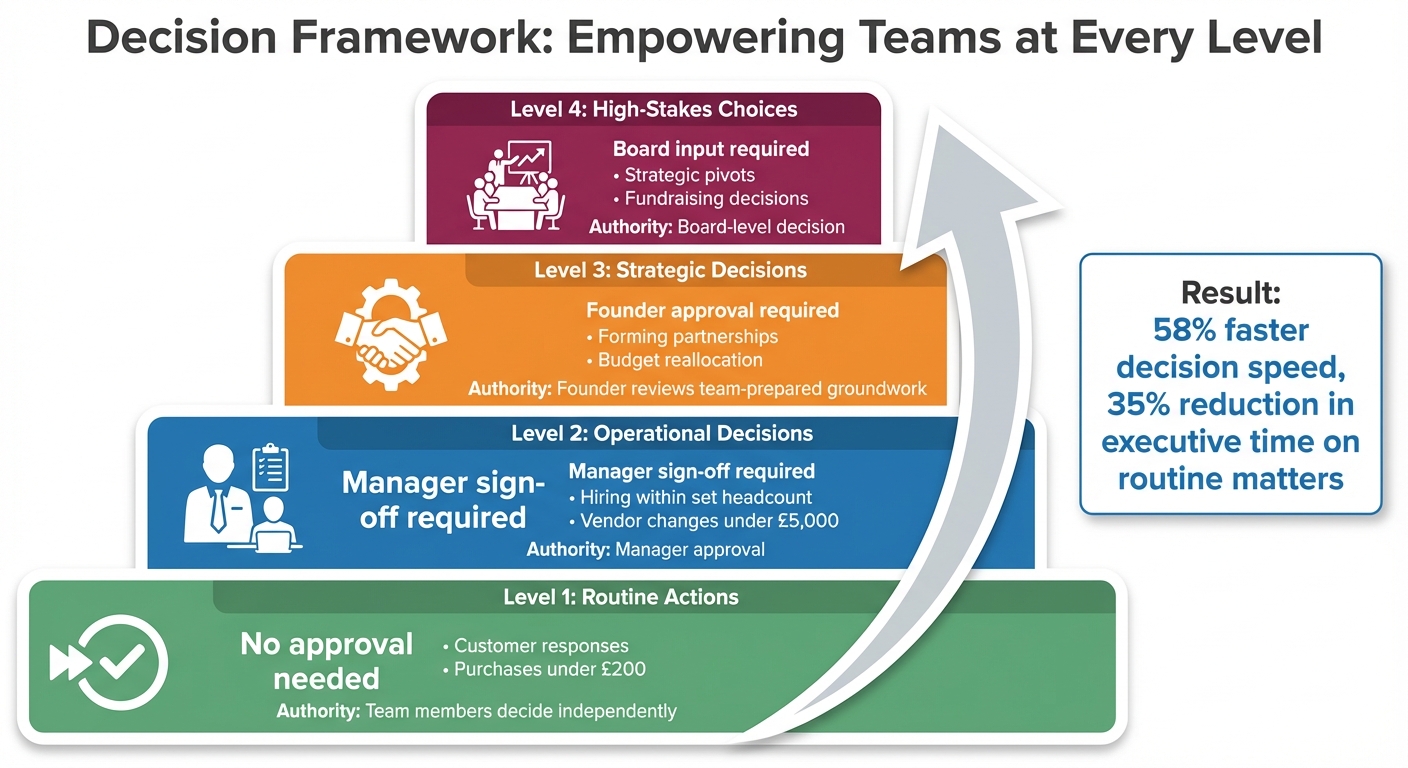
4-Level Decision Framework for Team Autonomy
Creating teams that can make decisions without constant oversight is a game-changer for scaling a business. Instead of relying on founder-led choices, you need systems that empower your team. This means establishing clear decision frameworks, documenting your expertise, and putting governance structures in place to maintain accountability without micromanagement.
Creating Decision Frameworks
Start by categorising decisions into four levels:
- Level 1: Routine actions like customer responses or purchases under £200 – no approval needed.
- Level 2: Decisions like hiring within a set headcount or vendor changes under £5,000 – manager sign-off required.
- Level 3: Larger decisions, such as forming partnerships or reallocating budgets, which need founder approval but allow the team to prep the groundwork.
- Level 4: High-stakes choices like strategic pivots or fundraising – these require board input.
To further streamline, apply the Bezos framework. Separate irreversible, high-risk decisions (Type 1) from reversible, low-stakes ones (Type 2). Type 1 decisions should involve the founder, while Type 2 decisions can be delegated. For example, a B2B SaaS company cut founder involvement in product decisions from 68% to 23%, improving decision speed by 58% and reducing executive time on routine matters by 35%.
For complex decisions, try the D/R/I/X method:
- Decider: The person accountable for the decision.
- Recommender: The one who analyses and suggests options.
- Inputs: Those who provide data within a set timeframe.
- Executor: The person responsible for implementation.
This approach avoids bottlenecks while ensuring all relevant perspectives are considered.
Turning Founder Knowledge into Business Systems
To scale effectively, you need to document your expertise. This isn’t about adding red tape – it’s about giving your team the context to make informed decisions when situations deviate from the norm.
"Delegation isn’t about letting go. It’s about documentation."
- Yuval Karmi, Founder & CEO, Glitter AI
Use Decision Briefs to capture your insights. Each brief should include:
- Context: Why the decision matters.
- Options: The available choices.
- Trade-offs: Pros and cons of each option.
- Recommendation: The suggested course of action.
- Owner: Who is responsible.
- Evidence: Supporting data.
- Metrics: How success will be measured.
These briefs create a knowledge library that your team can refer to for similar decisions in the future.
The CRAFT Cycle is a practical way to put this knowledge into action:
- Clear picture: Define the process and success criteria.
- Realistic design: Develop a minimum viable solution.
- AI-ify: Build automation or playbooks.
- Feedback: Test and refine.
- Team: Train and assign someone to maintain the system.
Focus on documenting the logic behind decisions rather than getting stuck on specific tools – business principles outlast technology.
When delegating, use a phased approach:
- I do, you watch.
- You do, I watch.
- You do, I review.
- You do, you own.
This gradual process builds confidence and ensures quality.
Setting Up Decision Governance
Governance isn’t about control – it’s about providing clarity. Start by creating a Decision Inventory of the 12–20 decisions that have the most impact on your business, such as pricing changes, hiring approvals, or feature prioritisation. Assign ownership and authority levels using RACI matrices to avoid confusion.
Adopt OODA rituals (Observe, Orient, Decide, Act) to regularly review decision briefs and update playbooks based on recent experiences. This creates feedback loops that improve decision quality without adding unnecessary oversight. Well-structured processes can cut meeting times by 23% and speed up execution by 31%.
"When your team doesn’t need you to function, you’ve built a system. That’s the ultimate form of scale."
- Richard Naimy
Shifting the focus from "Who is doing this?" to "Who owns the outcome?" changes how teams operate. Founders who delegate early achieve 30% faster growth compared to those who try to control everything. Plus, it helps prevent burnout, which affected over 50% of startup founders in 2024.
Using Technology to Support Independent Decision-Making
Breaking free from founder-led decision bottlenecks requires leveraging technology to embed your expertise into your team’s workflow. The idea is simple: technology can amplify your team’s ability to make informed choices by capturing not just what decisions you make, but why you make them. This ensures your team can act with confidence, even when you’re not directly involved.
AI-Powered Knowledge Management
AI tools can transform your scattered expertise into a centralised, searchable resource that your team can access instantly. For instance, platforms like Notion AI allow employees to query company documentation and get immediate answers. Instead of waiting for your input on a client response, a team member can consult the AI system and receive guidance based on your past decisions.
Custom AI agents take this even further. Tools like ChatGPT Teams or Claude Projects can be trained to reflect your brand voice, quality standards, and decision-making patterns. A practical way to do this is by recording a 30-minute session where you explain your decision process, transcribing it, and using it to train the AI. Providing 10–15 examples of past decisions can establish a reliable framework. This allows your team to produce drafts or solutions aligned with your standards, which they can then refine instead of starting from scratch.
"AI works best as a ‘decision support system’ for your team, not as a replacement for human work."
- Kristen Poborsky, AI Business Consultant
The underlying technology, Retrieval-Augmented Generation (RAG), ensures that AI responses are based on your curated internal sources, not fabricated information. These responses come with source citations and timestamps, keeping the information trustworthy and auditable. This approach reduces the "Mean Time To Source Information", enabling quicker decision-making cycles.
Data-Driven Decision Support
Real-time data access empowers your team to make decisions based on facts, not assumptions. Tools like Tableau and Power BI provide insights into key metrics – such as customer behaviour, financial health, and operational performance – allowing your team to act independently without waiting for your input.
The benefits are clear. 85% of businesses report saving time within eight weeks of implementing AI workflows one step at a time. However, attempting to automate everything at once often leads to failure, with success rates dropping to just 40%. Starting small is key. For example, you could begin by automating responses to common client FAQs or generating weekly performance summaries, then expand as the system proves effective.
A great example of this approach is Seam AI, a 10-person team that developed a "data-extraction GPT." This tool writes SQL queries to pull customised datasets from their internal systems, enabling business users to access data without needing technical expertise. By making data self-service, the team can make decisions faster and more confidently.
Tools That Enable Team Autonomy
The right tools bridge the gap between information and action. For instance, Notion acts as a centralised knowledge hub where pages can be marked as "verified." It even alerts subject matter experts when content is outdated, ensuring the AI doesn’t retrieve irrelevant information. Meanwhile, tools like Slack Workflows and Zapier automate routine processes, such as routing approvals or updating statuses, so decisions can move forward without unnecessary delays.
To capture the nuances of your decision-making, screen recording tools like Loom are invaluable. They allow you to explain the reasoning behind each step as you perform a task. These recordings become a resource your team can refer back to, filling in the gaps that static, text-only SOPs often leave.
| Tool Category | Practical Examples | Purpose for Autonomy |
|---|---|---|
| Knowledge Hubs | Notion, Confluence, SharePoint | Centralised "shared truth" for teams and AI |
| Decision Support | Tableau, Power BI | Real-time data visibility for informed choices |
| Process Capture | Loom | Recording decision logic for training |
| Workflow Automation | Slack Workflows, Zapier | Automating approvals and updates |
Consider the example of the San Antonio Spurs, who increased AI fluency across their organisation from 14% to 85% by embedding training into daily workflows rather than treating it as an isolated task. This highlights how integrating technology into existing routines makes adoption smoother and more effective.
To move towards founder-enabled decision-making, start small. Identify one recurring task – like content approvals, pricing decisions, or onboarding queries – that consumes your time. Document your process, load it into an AI tool, and let your team test it for a month. The goal isn’t perfection but progress. By enabling independent, informed decision-making, you’re building a foundation for sustainable growth.
Conclusion: From Founder-Led to Founder-Enabled
Shifting from founder-led to founder-enabled decision-making isn’t about stepping back – it’s about creating room for growth. When every decision has to go through you, scaling up becomes a daunting task. Businesses with revenues between £1–5 million often hit a ceiling when founders become the bottleneck for decisions.
"Letting go is not a loss of control; it’s the creation of capacity."
- Ben Allman, Partner, Ballards LLP
The way forward involves three key strategies: establishing decision frameworks to clarify authority, documenting your expertise to preserve institutional knowledge, and leveraging technology to make both accessible to your team when needed. Companies that adopt well-defined processes and decision-making structures see real results: a 23% reduction in meeting time and a 31% increase in execution speed. Even more crucially, they create businesses that don’t rely on the founder for every single decision.
This shift brings measurable benefits. It enhances your business valuation by lowering the perceived risks for potential buyers who worry about over-reliance on a single individual. It also helps attract and retain talented employees who value autonomy and dislike micromanagement. Most importantly, it frees you to focus on high-impact priorities – like market strategy, innovation, and long-term planning – rather than being bogged down by day-to-day issues. These advantages pave the way for meaningful, step-by-step progress.
"Your value isn’t in how much you do, but in how well the system runs without you."
- Jeremy Rosmarin, Sidecar Capital Partners
Start small. Identify one repetitive decision that consumes your time, document the process, and delegate it with clear guidelines. The goal isn’t to remove yourself entirely but to build a business that can thrive without your constant involvement.
FAQs
Which decisions should I stop approving?
Stop signing off on routine tasks or decisions your team can handle on their own. Things like approving expenses under £50, minor project details, or routine hiring choices can be delegated. This not only eliminates unnecessary delays but also encourages your team to take ownership and operate independently. Instead, concentrate on establishing clear guidelines and fostering trust. By doing so, you empower your team to make decisions confidently within their remit, which boosts both their accountability and overall productivity.
How do I delegate without losing quality?
To delegate well while maintaining high standards, start by laying out clear processes and ownership structures. Make sure everyone understands their roles, responsibilities, and the expected outcomes. This clarity fosters alignment and builds trust within the team.
Documenting workflows, setting measurable benchmarks, and granting decision-making authority can help minimise confusion. Instead of simply assigning tasks, focus on giving team members ownership of broader responsibilities. This approach encourages autonomy while ensuring accountability and a commitment to ongoing improvement.
How can AI help my team decide faster?
AI helps accelerate decision-making by acting as a support system. It provides rapid insights, automates repetitive decisions, and alleviates decision fatigue. This enables your team to make well-informed choices more efficiently, freeing up time to concentrate on more critical tasks.
Related Blog Posts
Create the Flexibilty You've Always Craved
Reclaim control and build real independence.
We respect your inbox. No spam, just meaningful updates.