7 Signs Your Business Depends Too Much on You
13 February 2026
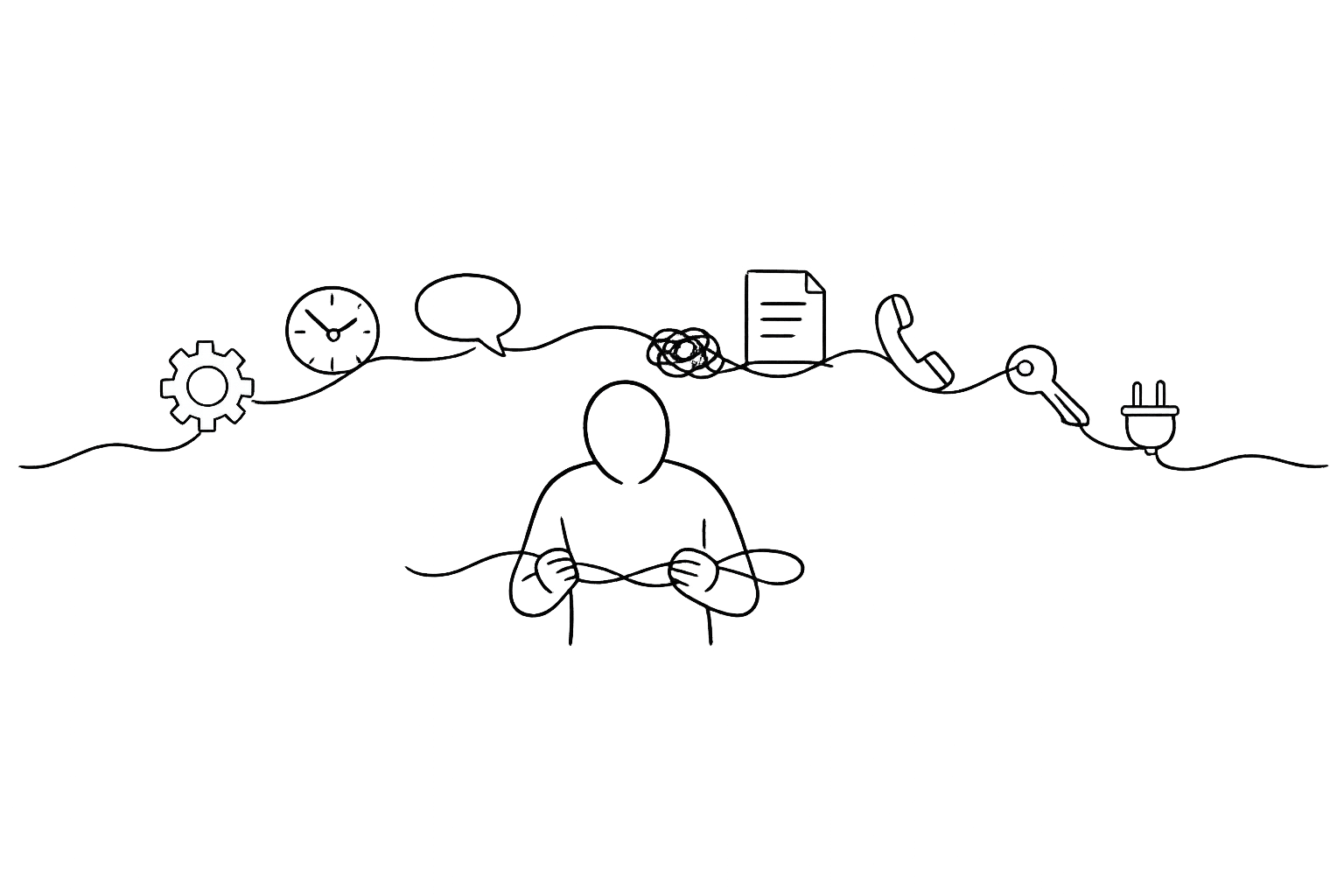
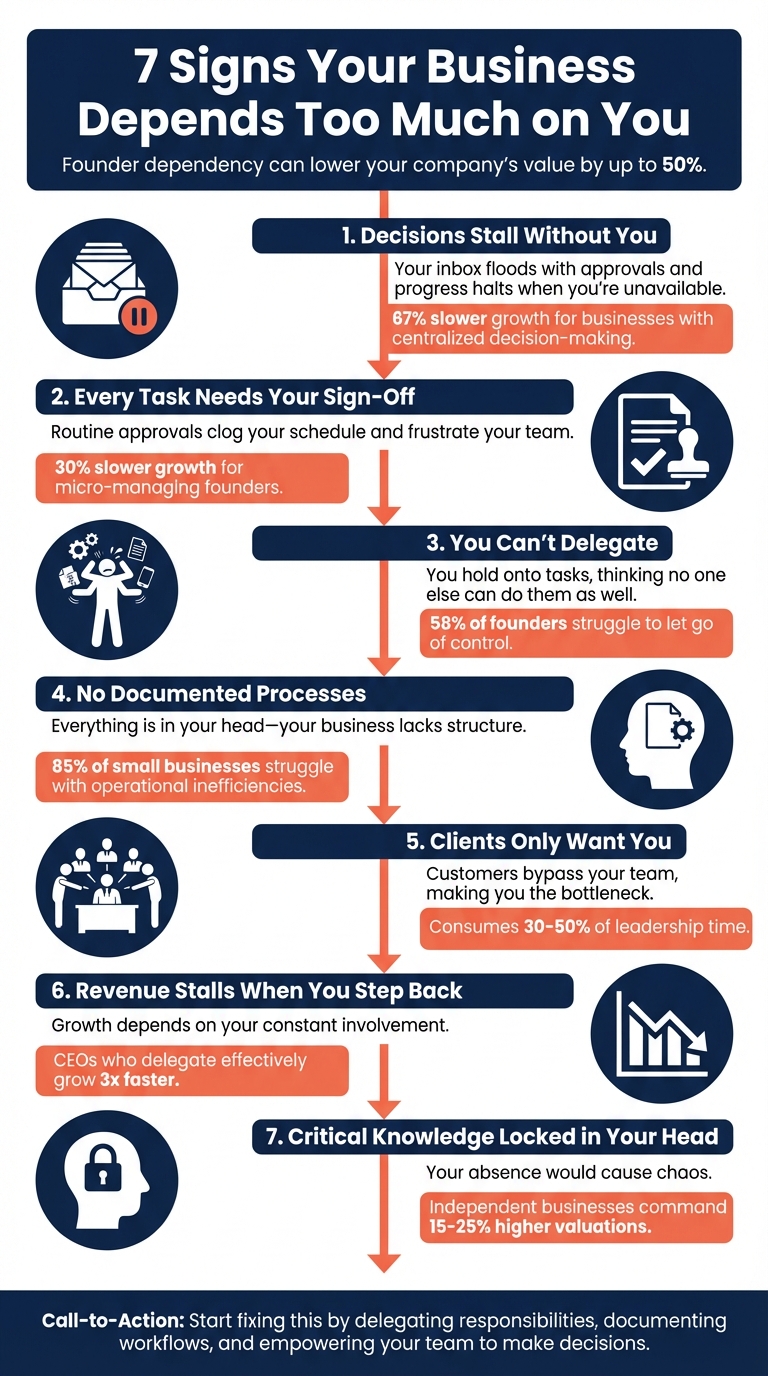
If your business falls apart in your absence, it’s a warning sign that it’s overly reliant on you. Founder dependency slows growth, frustrates employees, and can even lower your company’s value by up to 50% during a sale. Here are the seven biggest signs to watch for:
- Decisions stall without you: Your inbox is flooded with approvals, and progress halts when you’re unavailable.
- Every task needs your sign-off: Routine approvals clog your schedule and frustrate your team.
- You can’t delegate: You hold onto tasks, thinking no one else can do them as well.
- No documented processes: If everything is in your head, your business lacks structure.
- Clients only want you: Customers bypass your team, making you the bottleneck.
- Revenue stalls when you step back: Growth depends on your constant involvement.
- Critical knowledge is locked in your head: Your absence would cause chaos.
Fixing this starts with delegating responsibilities, documenting workflows, and empowering your team to make decisions. For example, set financial thresholds (e.g., allowing managers to approve expenses up to £5,000) and create step-by-step guides for key tasks. Long-term, this not only reduces stress but also boosts growth and increases your business’s value.
7 Signs Your Business Depends Too Much on You
Founder Dependency: How to Spot It and How to Remove It
sbb-itb-9e8c2f9
1. Decisions Stall Without Your Input
When your team relies on you for every decision, progress grinds to a halt. This phenomenon, called upward delegation, happens when employees push decisions back to you instead of making them themselves. Often, they fear being second-guessed or aren’t sure they have the authority to act.
The signs are hard to miss. Your inbox overflows with approval requests, your calendar is packed with unnecessary check-ins, and projects hit a standstill whenever you’re unavailable. Even straightforward issues, like minor customer service complaints or approving expenses under £5,000, somehow end up on your plate. Holding onto control over these small decisions creates a backlog that slows everything down. And these delays? They don’t just waste time – they can seriously hinder growth.
The numbers paint a clear picture. Businesses where decision-making is overly centralised grow 67% slower than those with distributed systems. In many UK-based SMEs, leaders lose 30–50% of their time to reactive problem-solving instead of focusing on strategic goals. Companies where CEOs delegate effectively grow three times faster than those where decision-making is tightly controlled.
"Control feels like safety… until it becomes congestion." – Vani Malik
So, how do you fix this? Start by implementing a Decision Rights Model like DARE (Decide, Approve, Recommend, Execute) to clarify who owns which decisions. Introduce financial thresholds – for instance, allow managers to approve expenses up to £5,000 without needing higher approval. When team members seek your input, try the "Ask-Before-Answering" approach: ask them what they recommend and why. This not only strengthens their decision-making skills but also shifts responsibility to where it belongs.
2. Every Task Requires Your Approval
Requiring your approval for every task can turn into a major bottleneck for your business. When your team can’t move forward without your sign-off, invoices sit unpaid, customer queries remain unresolved, and projects stall. This isn’t just inconvenient – it’s a structural issue that ties your business’s progress directly to your availability.
And the cost? It’s measurable. Founders who micro-manage task approvals see their business growth slow by 30% compared to those who delegate early. Instead of focusing on big-picture strategies, your inbox becomes cluttered with minor approvals, and your calendar fills with routine check-ins. High-performing employees often resist this kind of oversight, preferring autonomy.
"If every decision has to go through the founder, it creates delay, confusion, and frustration. Projects get stuck in limbo. Execution suffers." – Adam Miron, Founded Partners
To fix this, you can use the "Two-Type" framework to divide decisions into two categories. Type 1 decisions are high-stakes and irreversible, like major investments or partnerships, and should involve you. Type 2 decisions, on the other hand, are low-risk and reversible – think routine vendor choices or social media posts – and can be delegated. This not only lightens your load but also fosters a sense of ownership within your team.
For example, let managers approve routine expenses up to £5,000 to keep things moving. When team members seek your approval, ask them to come with a clear recommendation, not just a problem. This encourages them to think critically and act with confidence.
A practical step? Track every decision you make over a week. Note what triggered the decision, how long it took, and whether your input was truly necessary. Patterns of unnecessary involvement will become obvious. If your business would grind to a halt during a week-long holiday, it’s a clear sign your approval processes need rethinking. These insights are key to creating a business that runs smoothly without constant oversight.
3. You Struggle to Hand Over Responsibilities
Struggling to delegate is a common roadblock for many founders. In fact, 58% find it hard to let go of control. While being deeply involved may have been essential in the early days of your business, this same behaviour can now hold you back.
This reluctance often comes down to three main beliefs: the efficiency trap – thinking it’s quicker to handle tasks yourself; the fear that others won’t meet your high standards, sometimes called ‘decision hoarding’; and tying your self-worth to being the go-to problem solver. Recognising these patterns is the first step to overcoming them.
The impact of not delegating can be significant. Businesses that rely heavily on a single decision-maker grow up to 67% slower than those with shared decision-making structures. On the flip side, CEOs who delegate effectively report 33% higher growth rates. If you’re planning to sell your business, founder-reliant companies often fetch valuations 30% to 50% lower than their systemised counterparts.
"Your relentless work ethic, once your greatest asset, transforms into your primary limitation." – Allison Dunn, Business Coach
To tackle this, start by auditing your time over one to two weeks. Categorise tasks into four groups: ‘Only me,’ ‘Train someone,’ ‘Systemise,’ or ‘Stop’. You’ll likely find that many ‘Only me’ tasks can, in fact, be delegated. Introduce progressive authority – set clear boundaries, like allowing managers to approve expenses up to £5,000 without needing your input. When team members bring you a problem, ask for their recommendation before stepping in. This not only develops their decision-making skills but also frees you up to focus on the bigger picture.
4. Your Business Lacks Documented Processes
If your team operates inconsistently, it’s a clear sign that your business is missing proper documentation. Without written processes, you’re left relying on memory to manage routine tasks, which pulls focus away from strategic priorities. This is a common challenge – 85% of small businesses struggle with operational inefficiencies due to inconsistent processes.
One way to gauge this problem is by considering the "Bus Factor." If your business would grind to a halt in your absence – essentially having a Bus Factor of one – this highlights a major vulnerability. The issue isn’t just about continuity; it’s also about the mental strain of remembering routine tasks. This cognitive load limits your ability to focus on big-picture decisions.
"The human brain is terrible at storage. It is designed for creativity, problem-solving, and pattern recognition. When you force it to remember routine checklists, you reduce its capacity for high-level strategic thinking." – Ben Schmidt, Founder, IamBenSchmidt
Beyond the mental toll, the lack of documented processes can cost you financially. Businesses heavily reliant on their founders often face valuation discounts of 40–60%. On the flip side, businesses that embrace documented workflows can cut founder workload by up to 60% and grow 2.5× faster.
Getting started doesn’t have to be overwhelming. Focus on identifying the tasks that tend to stumble without your direct involvement. Record yourself performing these tasks and explaining your approach. Then, have a team member turn your recording into a simple, step-by-step guide. This "minimum viable process" approach gets critical workflows documented quickly. Additionally, clarify decision-making authority – like allowing managers to approve expenses up to £5,000 – to prevent bottlenecks. After all, processes must be consistent before they can be refined or automated. By systematising your workflows, you’ll reduce founder dependency and create a more resilient business.
5. Clients Only Want to Speak With You
When clients insist on dealing directly with you instead of your team, it’s a clear sign that your business revolves more around personal relationships than structured systems. Essentially, you’ve become the heart of the operation, rather than the company itself functioning as an independent entity.
This setup, often called the "hub and spoke" model, places you at the centre of all client interactions. While this might seem flattering, it consumes 30–50% of leadership time and limits growth to how much you, personally, can handle.
"We no longer just buy a business; we invest in a system and a team that runs it. If the system is in the founder’s head and the team is just the founder, we’re not buying a business. We’re hiring a very expensive, high-risk employee." – UK mid-market PE partner, StrategyHub
This heavy reliance on the founder creates financial vulnerabilities. Businesses tied too closely to their founders often face valuation discounts in the mid-market, while those with strong systems and teams in place tend to command 15–25% higher multiples. To reduce this dependency and make your business scalable, transferring client interactions to your team is essential.
The process mirrors delegating decisions and processes – key to sustainable growth. Start by categorising your client relationships into three groups:
- Personal: These require a gradual handover.
- Professional: These can be handed off immediately.
- Institutional: These are already system-based and don’t need your involvement.
Once categorised, introduce shadowing. Have a trusted team member join your client meetings so clients slowly get used to working with them instead of you. A good CRM system is also vital – it ensures all client interactions are recorded, keeping service seamless without relying on your memory.
If you’re considering an exit, start preparing early. Bring in second-tier relationship managers 18–24 months ahead of time to methodically transfer the trust and connections you’ve built. This approach not only reduces risks but also boosts your company’s long-term value.
6. Revenue Stops Growing When You Step Back
If your revenue hits a plateau the moment you step away or shift focus, it’s a clear indication that your business is overly dependent on you. This suggests that growth is tied more to your personal involvement than to a scalable system.
Your ability to grow the business is capped by your own capacity. Essentially, the company’s progress is limited by how much you can personally handle. This points to a broader issue: decision-making is too centralised. Research shows that 85% of small businesses encounter founder-driven bottlenecks, which directly hinder efficiency and scalability. For many UK businesses, this challenge becomes particularly evident when turnover reaches between £1 million and £5 million, as founders often remain the sole decision-makers.
Take Richard, for example, the CEO of a ground transportation company. He was working 80-hour weeks, personally managing every operational detail, until health challenges forced him to rethink his approach. By bringing in a COO and a Commercial Director, he cut his operational involvement by 70%. This shift allowed him to focus on strategic growth, including acquiring a Midlands-based company. That acquisition added £8 million in revenue and doubled the company’s growth rate within just one year.
The financial impact of founder dependence can’t be ignored. Businesses heavily reliant on their founders often face valuation discounts in mid-market deals. These companies typically see EBITDA multiples in the range of 5–6x, compared to the median of 9.8x for businesses with more independent operations.
So, how can you break this cycle? Delegation is key. Katie, the CEO of a tech consultancy, implemented a "Green/Amber/Red" decision-making framework in 2023. This system empowered her team to make decisions independently. Within three months, 85% of decisions were handled without her input, leading to a 60% improvement in client response times. Data shows that companies where CEOs delegate effectively grow three times faster than those with centralised decision-making structures.
7. Critical Knowledge Exists Only in Your Head
One major red flag for any business is when vital expertise resides solely with you. If all operational knowledge is locked in your head, the business becomes fragile – a single point of failure. This leaves the company vulnerable to disruptions, whether from illness, emergencies, or even a well-earned holiday. The risks here aren’t just operational; they’re financial too.
When critical knowledge isn’t shared, it affects your business’s valuation. Buyers tend to penalise such businesses, offering lower valuation multiples. On the flip side, companies that run independently of their founders can secure 15–25% higher valuation multiples compared to those that are founder-dependent. A UK mid-market private equity partner summed it up perfectly:
"If the system is in the founder’s head and the team is just the founder, we’re not buying a business. We’re hiring a very expensive, high-risk employee."
This isn’t just about numbers. It can also cause frustration among talented employees, pushing them to leave. Decision-making slows down as every issue requires your input, leading to "decision latency". And here’s a startling fact: 30–50% of leadership time in UK SMEs is spent on reactive problem-solving instead of focusing on strategic growth.
So, what’s the fix? The first step is to translate what you know into systems and processes that others can follow. AI-powered tools can help standardise and transfer this knowledge. Ben Allman, Partner at Ballards LLP, highlights the importance of this shift:
"The founder’s implicit knowledge must become explicit. Standard operating procedures, decision-making frameworks, and quality standards need documentation that allows others to execute consistently."
This involves creating SOPs (Standard Operating Procedures), introducing decision-making frameworks like DARE (Decide, Approve, Recommend, Execute), and even running scheduled absence tests to identify gaps in your systems. By documenting and systematising your expertise, you pave the way for a scalable, resilient business.
How to Reduce Founder Dependency
If you’re noticing the warning signs of founder dependency, it’s time to take action. The key isn’t to work harder but to design systems that allow your business to function independently. Think of yourself not as the problem-solver but as the architect who builds processes that run smoothly without constant input.
Start with a Decision Diet. Over the course of a week, track the decisions you make and pinpoint the bottom 50% – the ones others could handle with clear guidance. Delegate these decisions with irrevocable delegation. For example, set financial thresholds, like allowing managers to approve expenses up to £5,000. This simple shift can significantly speed up decision-making – up to three times faster, in fact.
Next, make sure your expertise is captured and accessible. Founders often delay documenting processes because their pace doesn’t allow for it. Tools like Scribe AI or Loom can help record your decision-making steps, turning your knowledge into a searchable training library. As David Jenyns, founder of SYSTEMology, advises:
"You probably shouldn’t document your own systems. Find someone who thinks in processes".
Leverage technology to streamline further. AI tools like CustomGPTs or ChatGPT for Teams can act as internal knowledge hubs, answering team questions based on your company’s specific guidelines. Workflow automation tools such as Zapier AI and Make can take over repetitive tasks – like sending invoice reminders, scoring leads, or scheduling meetings – giving you more bandwidth for strategic priorities. Focus on automating the 20% of tasks that consume 80% of your time.
Finally, put your systems to the test with a Forced Absence Test. Plan a two-day period where you’re completely unavailable. Any issues that arise will highlight areas where processes need improvement. For instance, between 2024 and 2025, a creative agency in London with £8 million in revenue introduced standardised project frameworks and empowered team leads. This allowed the founder to step away for 30 days without disruption. The business later sold for 40% above its initial valuation, with buyers pointing to its well-structured operations as a major asset.
Conclusion
If you notice signs like stalled decision-making, constant approval requests, client over-reliance, or critical knowledge locked in your head, it’s time to take action. Founder dependency drains resources and slows down growth – businesses tied to a single leader grow 67% slower than those with shared decision-making responsibilities.
The operational and financial downsides of founder dependency make it a risky long-term strategy. When it’s time to sell, buyers see founder dependency as a liability, not an advantage. Management-independent businesses often secure valuation multiples that are 15–25% higher. On the flip side, founder-dependent companies see 30–50% of leadership time wasted on reactive problem-solving.
Shifting your focus from running the business to building it requires a new perspective. As Ben Allman, Partner at Ballards LLP, puts it:
"Letting go is not a loss of control; it’s the creation of capacity."
By systematising your operations and empowering your team, you can strengthen your business’s resilience and value. Start small – conduct a decision audit, document a key process, or experiment with stepping away for a couple of days. Each small step brings you closer to a business that thrives without your constant input, allowing you to focus on guiding its future rather than being trapped in the day-to-day.
Your business should be an asset that works for you, not a job that relies on you. The real question isn’t whether you’ll act, but how quickly you’ll start making those changes.
FAQs
What’s the fastest way to spot founder dependency in my business?
The fastest way to spot founder dependency is to check if major decisions, approvals, or actions hinge entirely on you. Some clear indicators include being the sole person with signing authority, having personal relationships with all your customers, or seeing revenue plateau – suggesting your business struggles to grow without your direct input. These signs point to the importance of delegating responsibilities and embedding knowledge within your team or processes.
Which decisions should I keep, and which can I delegate safely?
Keep control over decisions that shape the big picture – like approving budgets, major projects, and overarching strategies – to ensure everything aligns with your vision. Hand off routine and day-to-day tasks, such as operational duties and administrative work, as long as clear guidelines and limits are established. By delegating non-strategic decisions, you can prevent bottlenecks while keeping the key direction of your business firmly in your hands.
How do I document what’s in my head without it taking weeks?
When it comes to streamlining your operations, focus on creating straightforward, repeatable processes. Tools like checklists or flowcharts work wonders to keep things organised and easy to follow.
Start by targeting critical areas like onboarding new employees or managing product delivery. These are the backbone of your operations, so getting them right can make a big impact. To save time, you can use templates or process mapping tools – they’re great for laying out steps clearly and efficiently.
Keep your documentation simple and prioritise clarity over excessive detail. You don’t need to capture every tiny nuance; the goal is to make it understandable and actionable. If possible, involve someone experienced in creating processes – they can provide valuable insights and ensure nothing important is missed.
Ultimately, the aim is to build a system that can grow with your business, allowing you to step back while maintaining consistency and quality.
Related Blog Posts
Create the Flexibilty You've Always Craved
Reclaim control and build real independence.
We respect your inbox. No spam, just meaningful updates.